
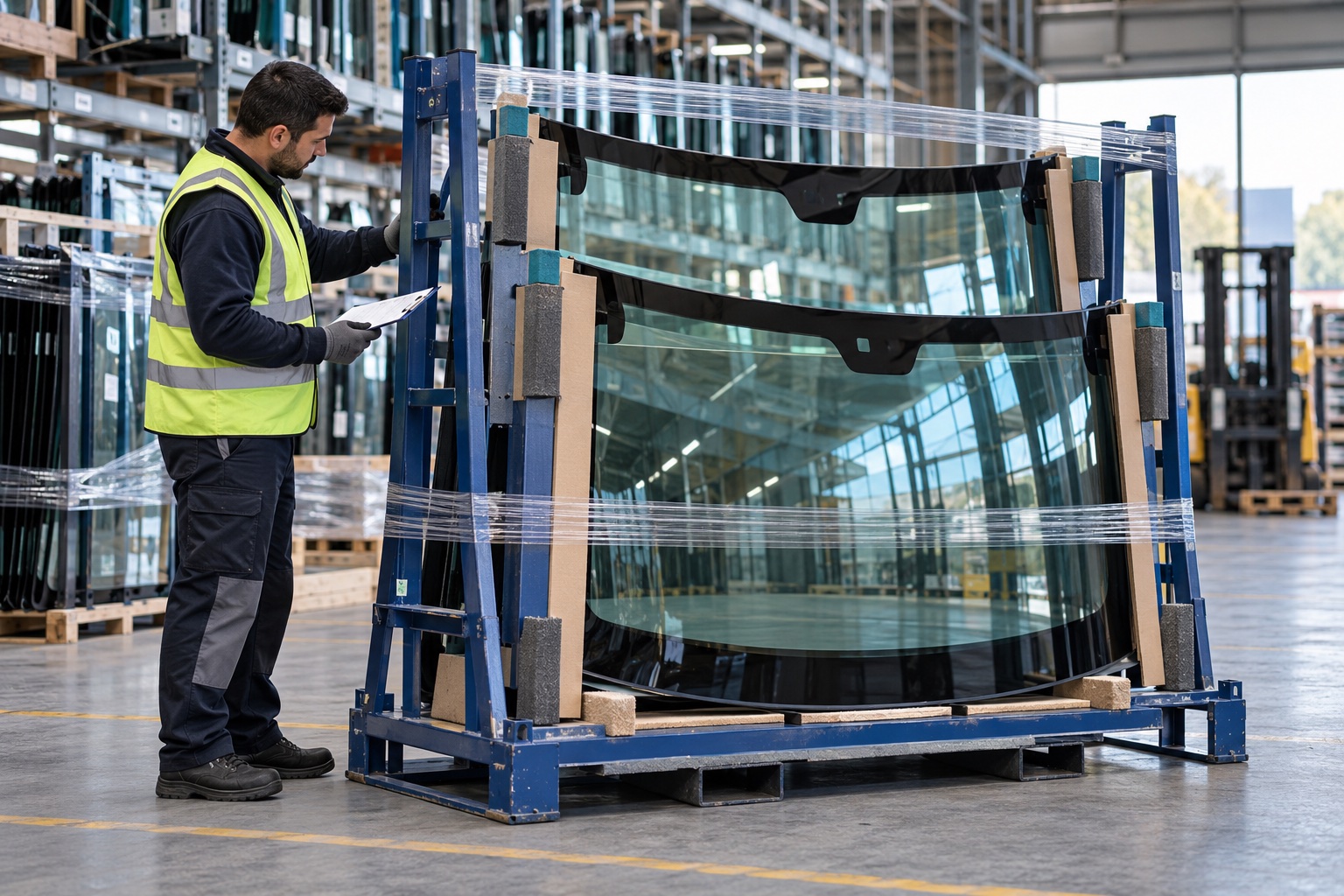
Automotive windshields need careful handling in storage and transit because of their large surface, curved shape and sensitive edges. Outer packaging alone cannot manage the risk: the supporting rack, contact points, loading pattern and restraint inside the vehicle must work together.
Assess the product and the transport unit together
Before dispatch, verify the vehicle model, left or right orientation, dimensions and any sensor or camera mounting areas. Separate incompatible glass types into identified slots rather than mixing them in one transport unit. Follow the manufacturer’s handling instructions and keep protective films in place; avoid hard materials that touch the glass directly.
Inspect the rack and every contact point
Keep windshields upright in an A-frame rack or purpose-designed transport stillage that matches the product dimensions, with separate slots for each pane. Use clean, sound cushioning compatible with the glass at all support points. Prevent edges from contacting metal surfaces, other panes or loose fittings. The rack base should be level, its connections maintained and its supports suitable for movement.
Restrain the rack, not the glass
Reduce movement in transit by applying restraint to suitable structural parts of the rack. Do not press straps or stretch film against the glass surface or vulnerable edges. For mixed pallet loads, distribute surrounding cartons evenly, prevent pallet overhang and check film tension on a sample load. Stretch film can help unitize a load; it does not replace a suitable rack or restraint method.
Standardize labels and receiving checks
Each transport unit should carry legible product or vehicle identifiers, quantity, orientation and order reference. The GS1 Logistic Label Guideline provides measurements for pallet barcode placement; put labels where warehouse and forklift operators can see and scan them, without the wrap obscuring them. Also check the rack for tipping or sliding risks during loading and unloading.
Validate the pack with a real shipment
Do not assess the packaging on an empty rack alone. Run a pilot with actual glass and the intended route, then inspect for contact with the rack or adjacent panes during transfer, vibration, braking and warehouse handling. Record damage by glass type, rack slot, route and restraint method. If laboratory testing is needed, select a procedure with a qualified packaging test provider that reflects the distribution profile; ISTA defines procedures for different shipment environments.
Sources
Accessed 1 November 2026. Validate against the distribution profile and the product manufacturer’s instructions; this guide does not replace product-specific technical guidance.
Review your shipment packaging with us
Explore stretch film options or contact Biz2miz to review packaging components for your shipment.
Frequently asked questions
Is stretch film enough on its own for windshield shipments?
No. Stretch film may help unitize a pallet or transport load, but it does not replace a rack suited to the glass, cushioning or correct restraint.
Can windshields be shipped horizontally?
The shipping orientation should follow the product and manufacturer instructions. Verify that the chosen rack supports the glass shape and prevents movement in transit.
How should shipment packaging be validated?
Run a pilot shipment with the real product, rack and route. Record damage, movement and receiving feedback; select a laboratory procedure suited to the distribution profile if needed.