
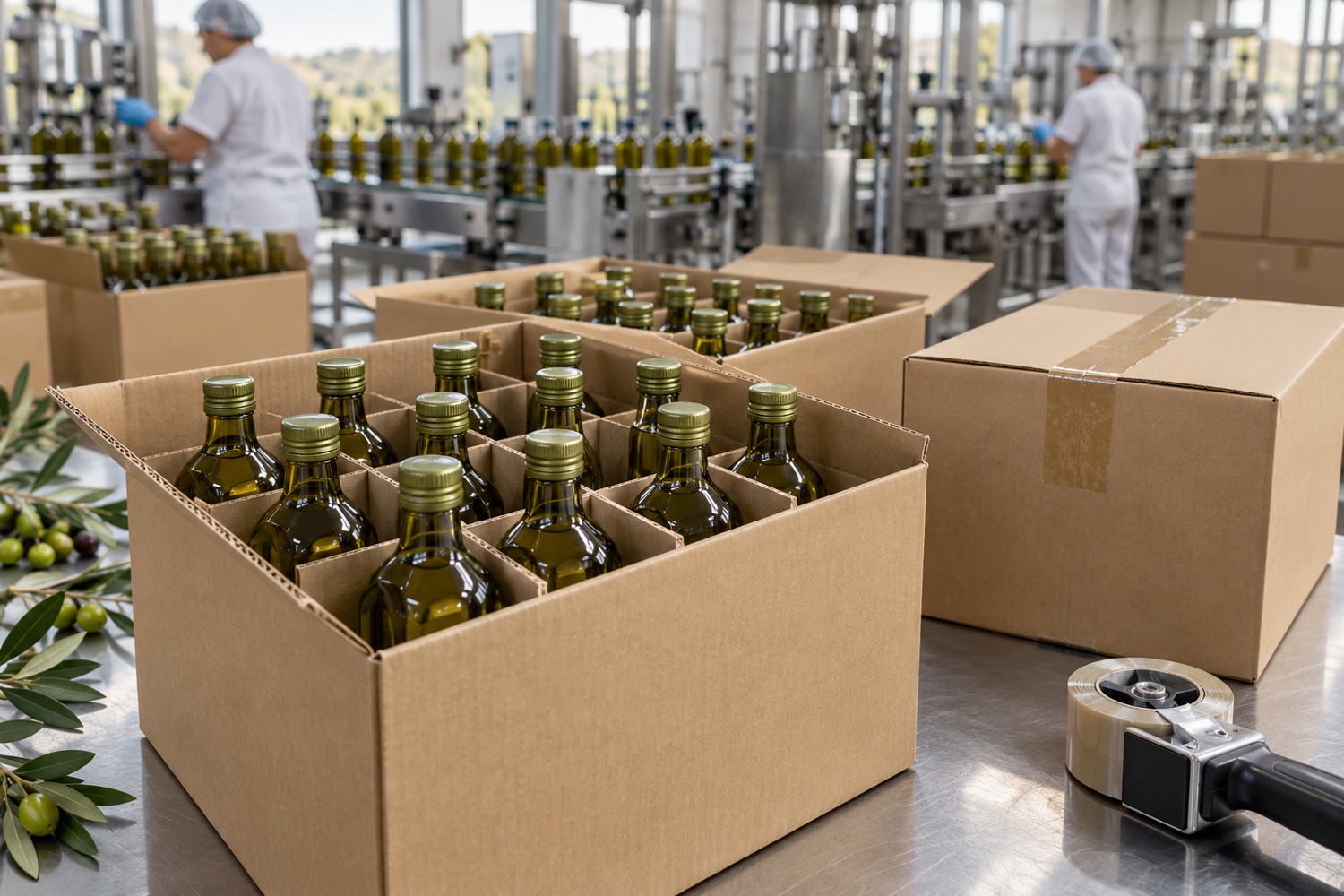
Loss from a glass bottle shipment can involve more than breakage: leakage, label damage and contamination of neighbouring goods also affect operations. For olive oil, consider closure checks, bottle spacing, carton strength and pallet restraint as one system. Validate the pack in a representative shipment using the actual bottle, fill weight and distribution channel.
Inspect bottles and closures before packing
After filling, check that caps are correctly closed and that bottles have no visible cracks or defects. For liquid goods, evaluate inner sealing and individual leak-resistant bags where appropriate for the product and applicable requirements.
If bottles are shipped upright, dividers should stabilise the body without allowing necks and caps to collide. Avoid designs that transfer the bottle’s weight only through the cap or neck.
Match partitions to the carton
Partitions should prevent bottle-to-bottle contact without creating excess empty space that allows movement. Check divider dimensions against actual bottle tolerances and filled weight. Select the carton base and closure for the combined load.
Seal the centre seam and relevant edges with suitable packing tape. Board should be clean and dry, and the tape should make firm contact along the joint. Choose tape by testing it with the carton, line speed and storage conditions rather than relying on one roll specification alone.
Plan pallet layout and stretch wrapping
Keep cases within the pallet footprint and build level, balanced layers. Avoid placing heavy liquid cases on top; where mixed products share a pallet, verify load distribution and stacking compatibility. A level top layer helps support the unit load during transit.
Stretch film can unitise the pallet, but apply controlled tension to avoid crushing cartons. Keep labels and barcodes visible. Assess separate weather protection where needed; do not treat stretch film as a leakproof outer pack.
Prepare for leakage and damage checks
Use a representative case to check loose closures, bottle contact, carton-base failure and tipping risks. Where drop or vibration testing is necessary, select a protocol suited to the distribution channel.
Show lot, quantity and product identification on pallet labels, and reconcile carton counts with dispatch documents. At receipt, inspect for moisture, oil marks, crushing and opened seams, and retain photographic records.
Sources and further reading
Accessed 28 October 2026. Follow current manufacturer, carrier and applicable regulatory instructions for the actual shipment.
Review packaging for your process
Share product dimensions, pack configuration and shipping route so suitable packaging options can be reviewed.
Frequently asked questions
Should bottles always ship upright?
That depends on the bottle and pack design. Do not assume one orientation is suitable for every product without validating the divider, closure and carton together.
Does stretch film prevent bottle leaks?
No. Pallet wrap can help restrain a unit load; it does not replace the bottle closure or inner leak-containment system.
What should I test when choosing carton tape?
Test seam adhesion on the actual board with the case weight, application line, temperature and storage duration.