
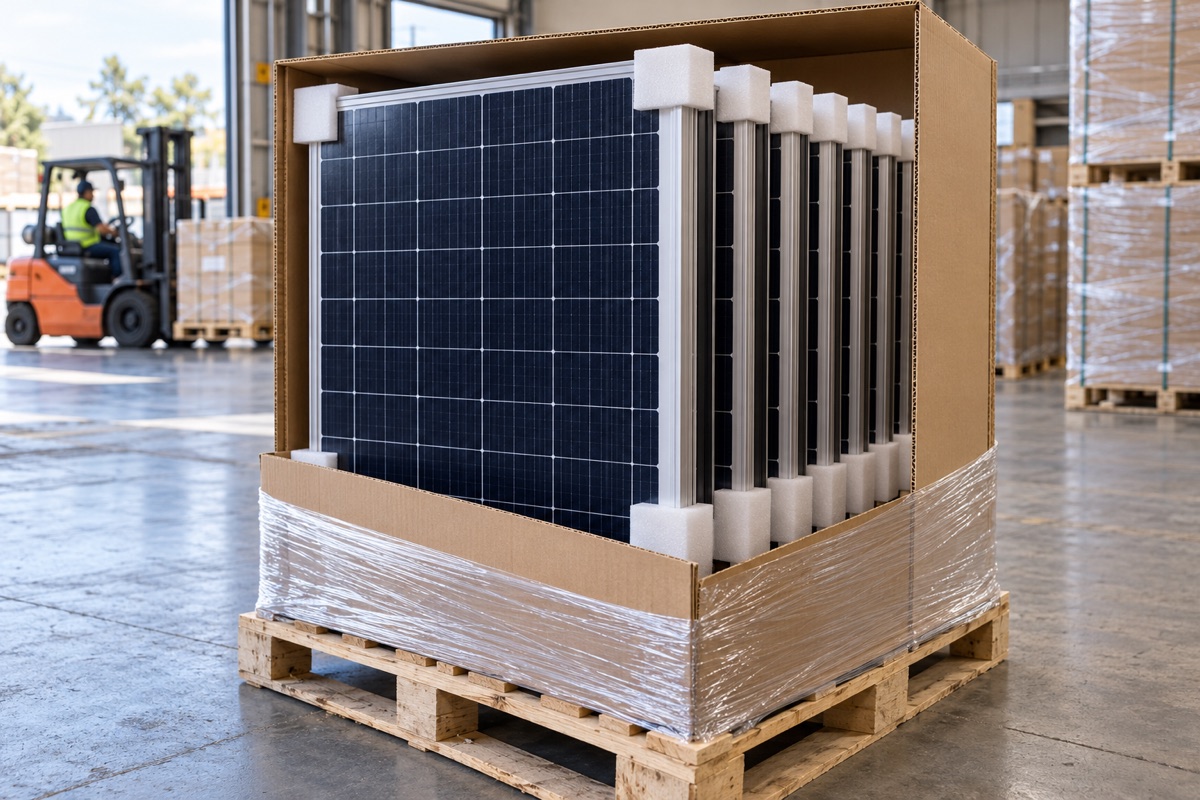
Photovoltaic modules are large, heavy products with glass surfaces. Shipping preparation is more than closing an outer carton: manufacturer packing and handling instructions, load restraint in the vehicle, protection from rain and inspection at receipt all need to work as one process. This guide is a general checklist; always follow the module maker’s current instructions for orientation, stacking limits and forklift handling.
Keep the manufacturer pack and pallet pattern intact
Carry the orientation, stacking and handling marks on the module pack into the dispatch instructions. Before opening or rearranging a pallet, match the product code and module count with the pallet condition and shipping documents. The permitted orientation and whether pallets may be stacked depend on the module and its packaging; do not assume a universal stacking limit.
LONGi calls for securing cargo against sliding, tipping or collapse and avoiding crushing or deformation of the pack. Inspect the pallet base and crate, keep the centre of gravity balanced, and plan loading with suitable lifting equipment.
Validate restraint around the pallet carefully
Stretch film may help unitise a suitably designed pallet load, but it does not replace the module maker’s original packaging or internal protection. Plan the wrap around the pallet and outer pack. Trial the tension on a representative load to make sure it does not crush the carton, damage corners or allow movement during transport.
If corner protectors or edge supports are used, check that they distribute restraint forces and do not create point pressure on the module frame. Keep straps, banding and wrap within the application points permitted by the packaging instructions. Hold damaged or wet packs for inspection before dispatch.
Plan dry storage, careful handling and a receipt record
Manufacturer guides emphasise suitable forklifts and trained operators, even support under the pallet and avoiding sudden impact or vibration. Select fork length, entry direction and lifting capacity for the pallet; do not let forks, the forklift backrest or loose cargo contact the module pack. The handling team should use the method specified for the actual product.
Stage packs in a clean, dry and protected area. Where rain protection is needed, use an outer cover without puncturing the original pack or trapping water, and inspect it for the storage conditions. Before dispatch and on arrival, photograph pallet shift, crushing, tears, moisture and visible damage with time, lot and carrier details. If damage is suspected, follow the maker’s and carrier’s inspection and notification procedure.
Sources and further reading
Follow the current manual for the exact module model and packaging configuration.
Review the packaging for your process
Share module pack dimensions, dispatch route and pallet configuration to review suitable Biz2miz options.
Frequently asked questions
Is stretch wrap alone enough to secure a solar-module pallet?
No. Wrap may help restrain a suitable pallet load; it does not replace the manufacturer’s module packaging, internal supports or handling instructions.
Can solar-module pallets be stacked?
That depends on the module and its packaging. Check the markings and current instructions for the shipped model before stacking.
What should be recorded at delivery?
Photograph pallet shift or tilt, crushed/torn/wet packaging, label and quantity checks, and visible damage together with shipment details.