
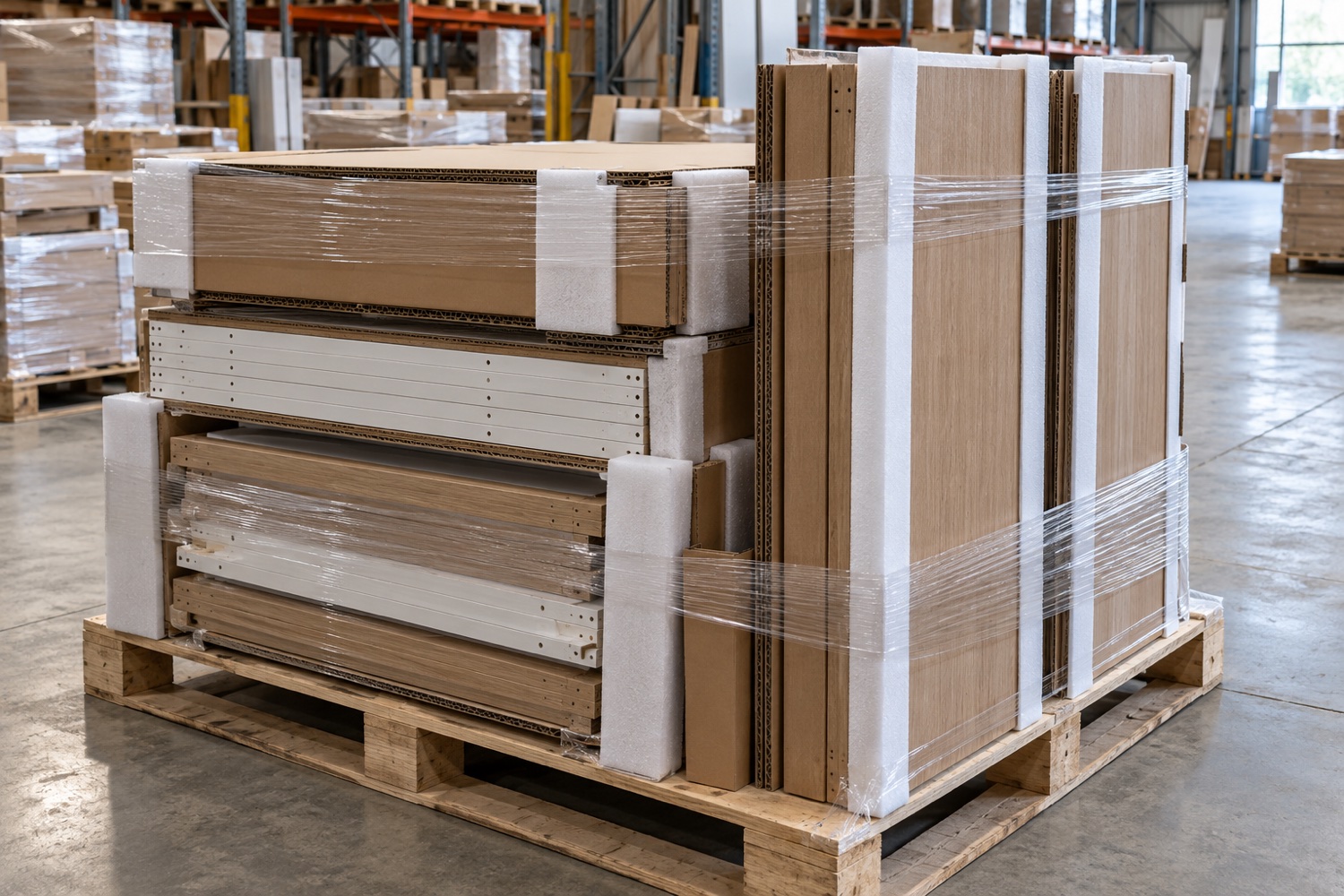
Kitchen cabinet doors are broad, flat and finished, so they are vulnerable to scuffing, corner impact and layer movement. Packaging should address surface protection and the support needed to prevent panel flex together. Do not standardise protective film or tape without a compatibility trial on the actual finish.
Select protection compatible with the finish
Laminated, painted, lacquered and foil-faced surfaces have different adhesion and removal tolerances. Before applying protective film or surface-protection tape, test an inconspicuous area at the actual dwell time and storage temperature. After removal, check for residue, colour change or gloss variation.
Use a clean, non-abrasive separator between panels instead of stacking finished faces directly together. Dust or hard particles trapped in a protective layer can scratch a surface under wrap pressure.
Support corners and edges in a flat pack
Corner profiles and edge guards protect vulnerable panel areas from impact. Internal supports should prevent doors from pressing against one another or overlapping edges from leaving marks. Use a handling base suited to the panel length.
Unsupported long panels may flex or suffer vibration damage. Determine orientation and stacking limits from the panel manufacturer and construction; one universal limit does not suit every door type.
Control pallet wrapping and movement
Secure the panel pack on a flat pallet with support under all edges. Tier sheets can help manage friction and load transfer. If straps are used, distribute pressure through edge guards and check for indentation on a sample panel.
Stretch film can unitise the outer load, but it should not press directly on a decorative surface or create loose layers that allow panels to slide. Keep labels visible and communicate orientation to handlers.
Trial the pack and inspect on receipt
Stage a sample pack in storage and run it through pallet moves and vehicle loading. Remove the film after the expected dwell time and inspect finish compatibility, crushed corners and pack movement.
Before dispatch, record colour and product-code matching, protective layers, corner profiles and pallet condition. At receipt, photograph scratches, corner impact, moisture or film marks and link them to the lot details.
Sources and further reading
Accessed 28 October 2026. Follow current manufacturer, carrier and applicable regulatory instructions for the actual shipment.
Review packaging for your process
Share product dimensions, pack configuration and shipping route so suitable packaging options can be reviewed.
Frequently asked questions
Can protective film be used on every cabinet door?
No. Verify compatibility between the finish, adhesive and dwell time with a representative test.
Can stretch film scratch a panel finish?
Direct contact and trapped particles can create a marking risk. Check interleaves and wrap tension.
How should panels be stacked on a pallet?
Use a flat, fully supporting base consistent with manufacturer instructions, without overhang or uneven pressure.