
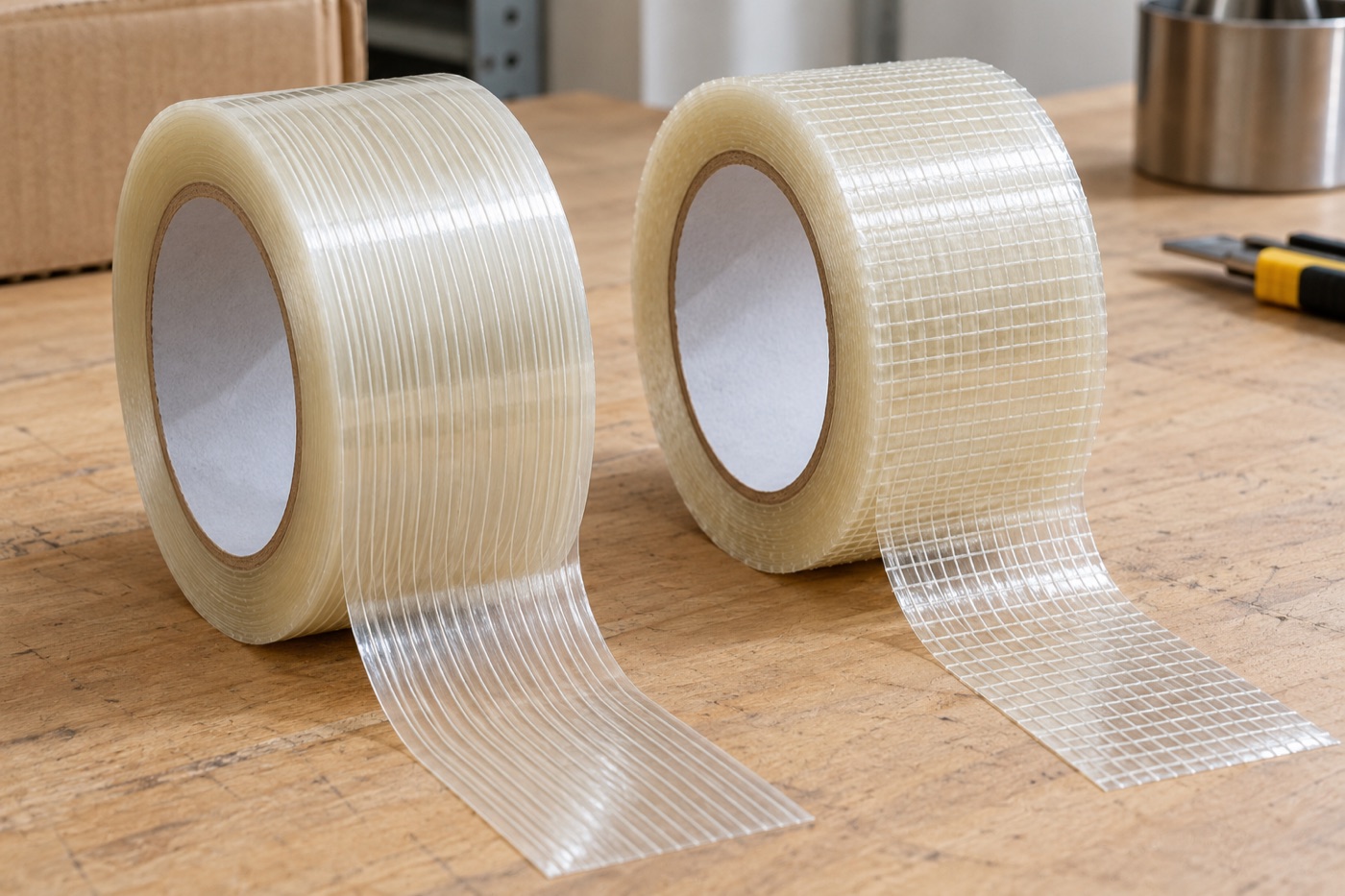
# Mono-Filament vs Cross-Filament Tape: What Is the Difference?
Filament tapes include reinforcement in the backing. Mono-filament designs generally run fibres along the tape length, while cross-filament constructions add reinforcement in both directions. Choose according to the forces expected in use, the surface and the technical data for the specific product.
Consider the direction of force
Bundling long items may place tension mainly along the tape. Where a carton edge or a transported package is stressed from multiple directions, a cross-filament construction may be worth evaluating. Fibre direction alone does not prove that one tape is always stronger: backing, fibre content, adhesive and overall design also matter.
Adhesion and tensile strength are different properties
Resistance to breaking is not the same as the ability to bond to a surface. Even a reinforced tape may perform poorly on a dusty, wet or incompatible surface. Review adhesion and tensile data with their test methods; do not assume a value measured on one surface applies to all others.
Plan a practical trial
- Carton sealing: Record carton type, packed weight, flap pressure and shipping duration.
- Bundling: Consider shape, sharp edges and potential movement of the items.
- Temporary fixing: Establish how long the tape must remain in place and whether the surface must remain undamaged on removal.
- For every application, test on a clean, dry representative surface and check the bond after normal handling and dwell time.
Tape is only one part of a load-securing system. Assess pallet design, suitable strapping and transport procedures independently.
Source: tesa — filament strapping tapes. This source describes the category; verify the specifications of the actual Biz2miz product in its technical documentation.