
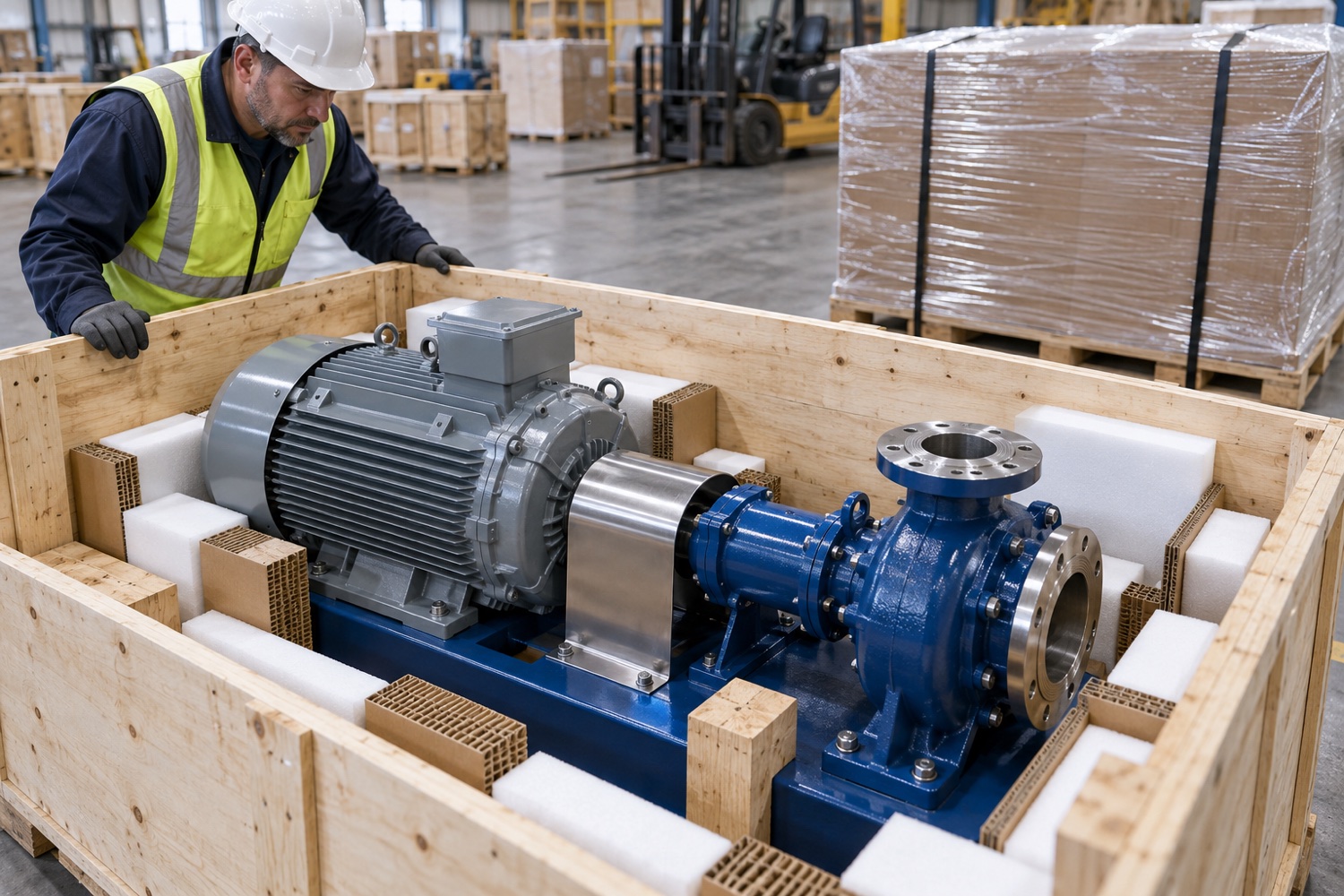
Packaging for pump and motor assemblies must support the equipment’s weight, protect moving parts and machined surfaces, and preserve access to lifting points. The crate, pallet, internal blocking and outer protection depend on the model and route. Product-specific lifting and preservation instructions take priority over general packaging guidance.
Confirm centre of gravity and lifting points
Identify the centre of gravity, manufacturer-approved lifting lugs and fork access. Secure the pump or motor to designed load-bearing blocks, not to a thin crate panel. Check that mounting fasteners and connections cannot loosen under vibration.
Protect pump openings, shaft ends and machined flanges with temporary covers suited to cleanliness and manufacturer requirements. Keep wood dust and moisture away from the equipment.
Control internal voids and surfaces
Supports should restrain the equipment in all directions and prevent metal-to-metal impact. Confirm that the closed lid does not press on the unit and that fittings and accessories are secured in separate compartments.
For moisture-sensitive equipment, select inner packaging, desiccants or barrier materials only from the product’s storage requirements and the expected transit duration. An outer cover alone does not control humidity inside a closed crate.
Design pallet and crate restraint
The crate base must carry the equipment and allow safe forklift access. Mark fixing points, lifting instructions and gross weight clearly. For longer routes, vehicle-level blocking and lashing may also be required.
An outer PE cover can help reduce rain and dirt exposure, but it must not block fork access, lifting points or required ventilation. Secure it to prevent water pooling and inspect for tears before dispatch.
Keep dispatch records and inspect at receipt
Before closing the crate, photograph the serial number, accessory list, flange covers and internal restraint. Match dimensions and weight with the carrier booking. Indicate stacking or orientation restrictions under your operating procedure.
At receipt, document crate damage, loose restraints, water marks or impact indicators. Carry out opening and acceptance under the purchase terms, carrier agreement and manufacturer inspection instructions.
Sources and further reading
Accessed 28 October 2026. Follow current manufacturer, carrier and applicable regulatory instructions for the actual shipment.
Review packaging for your process
Share product dimensions, pack configuration and shipping route so suitable packaging options can be reviewed.
Frequently asked questions
Can stretch film alone secure a pump motor to a pallet?
No. For heavy equipment, stretch film is not a substitute for engineered support, a crate and appropriate mechanical restraint.
Does a PE cover fully protect equipment from moisture?
No. An outer cover can reduce rain and dirt exposure; moisture control inside the pack requires separate design.
Should lifting points be hidden by the pack?
No. Keep the access and markings needed for safe lifting visible and consistent with manufacturer instructions.