
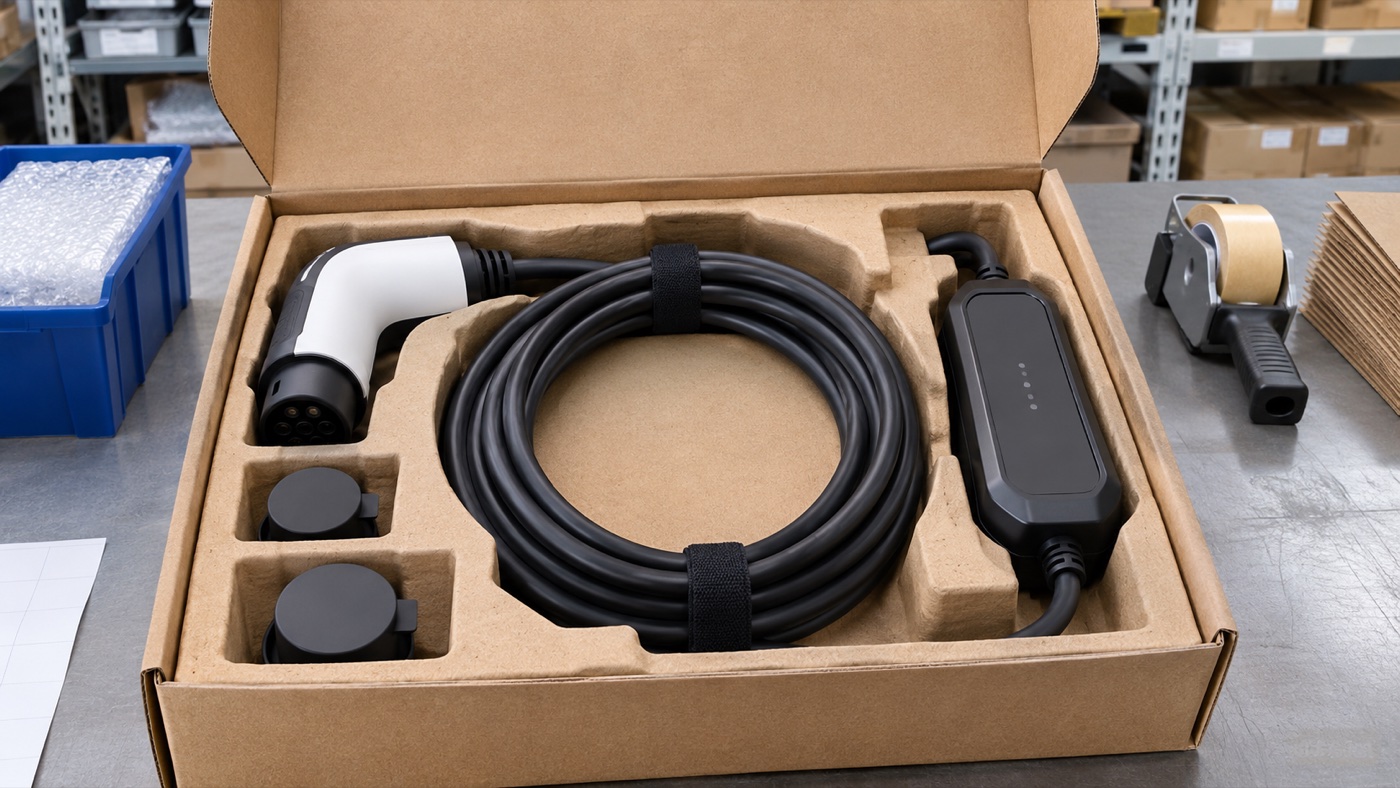
Portable electric-vehicle charging kits may contain a cable, connectors, a control unit and adapters, each requiring different protection. A tie that controls the cable coil does not protect connector faces or the electronic module; verify internal layout and the outer carton separately.
Define the kit and cable layout
Create a kit list for each variant, including cable length, connector type, control unit, adapters and instructions. Take technical decisions about the cable and device from the manufacturer’s documentation; a packaging guide does not certify electrical suitability, vehicle compatibility or charging performance.
Place the cable in a broad, controlled loop that follows the manufacturer’s bending and storage guidance. Sharp folds, tight bundling or placing accessories on top of the cable can create pressure inside the carton. Trial pack and unpack the sample to see whether the method is repeatable.
Separate connectors and the control unit
Use the connector caps or protectors specified for the product. Do not leave connector faces directed at the carton floor or a hard part; a separate corrugated pocket can reduce movement and contact. The control unit should not carry the weight of the cable coil.
Put adapters and small fittings in a countable inner pack. Match every item code to the order list; loose parts can scratch the cable or press on connectors. Packaging components must not cover product warnings or documentation.
Check the outer carton and pallet
Select carton dimensions around the stable fit of the entire set, not just the outside diameter of the cable coil. Close the case with suitable tape and check for even contact along the seam. When several cartons share a pallet, keep case code and quantity legible on the logistics label.
Stretch film helps hold cartons together on a pallet; it cannot replace internal cable restraint or connector caps. Trial the real transport layout and record pallet shift, carton crushing, label readability and the contents found at receipt.
Product identification and returns
Match the model and serial/lot information on the pack to the device marking, dispatch order and pallet record. The GS1 logistics label guideline offers a general framework for identifying logistics units. Before repacking a returned kit, count the cable, connector caps and accessories; leave electrical-condition decisions to an authorized technical inspection.
Sources and further reading
Accessed 3 November 2026. Confirm current product specifications, carrier requirements and applicable local rules before shipment.
Plan packaging around your operation
Share product dimensions, case layout and dispatch conditions so the suitable Biz2miz packaging options can be reviewed.
Frequently asked questions
How should the cable be restrained inside the carton?
Use a broad loop that follows the manufacturer’s storage guidance and secure it with a product-compatible support; avoid sharp folds and pressure.
Does a connector cap replace outer-carton protection?
No. The cap protects the connector face; the carton and inner pockets control movement of the complete kit.
Can pallet stretch wrap protect the cable kit by itself?
No. Pallet wrap helps unitize the external load; internal cable and component layout still matters.