
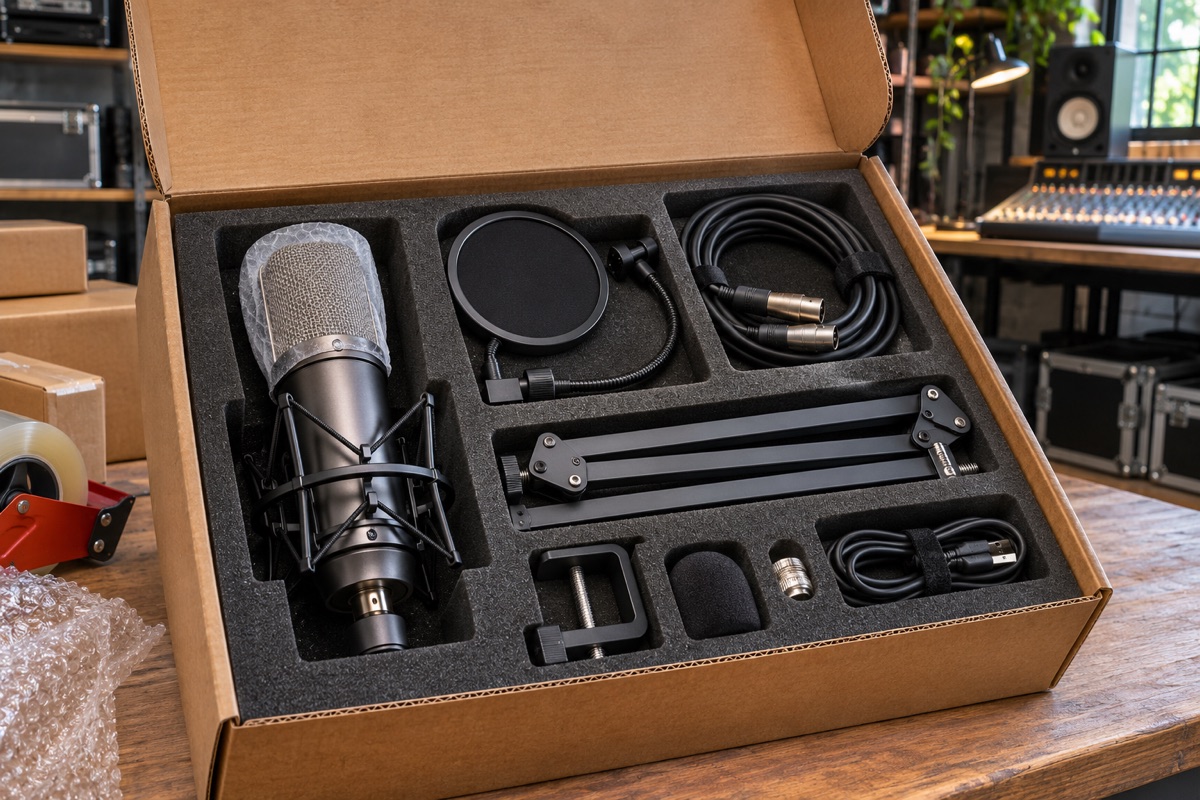
Studio microphone orders may include the microphone body, a carry case, connection cable, stand adapter and sometimes a power supply or wireless transmitter. Fitting every part into one carton matters less than preventing contact in transit and keeping the correct accessories with each model. Build the pack around the configuration and the manufacturer’s care and transport guidance.
Verify the microphone and accessory kit
Show model, serial number, case, clip, adapter, cable and optional parts as separate lines on the packing list. Shure user guides include model-specific care advice, such as storing a microphone in its protective case when not in use; use the actual product’s manual for the shipment instruction.
The capsule or grille, body finish and connectors may have different sensitivities. Keep the microphone in its protective case and place cables and stand parts in separate pockets. If no case is supplied, choose a surface-safe support for the product and verify on a sample that connectors are not under pressure.
Separate cables, stands and small accessories
Arrange a cable in a loose loop of the diameter recommended by its maker; tight bends or rigid ties can strain it. Restrain connectors so metal ends do not strike the microphone body or grille. Do not leave a stand arm, adapter or clip loose in the same void as the microphone.
Dividers in the outer carton can reduce picking errors and part-to-part contact. Design foam or board supports for the product; do not present them as a guarantee of sound quality, capsule performance or electronic protection. For wireless kits, check current carrier and regulatory requirements for batteries and battery transport separately.
Carton closure, labels and pallets
Choose a carton that accommodates the protective case and all accessories without loading the flaps. Apply carton tape to clean, dry board seams; it does not close the microphone case zipper or inner pack. Match model, quantity and order identity on the outer label.
For a group shipment, protect carton corners and maintain a stable pallet pattern. Stretch film can hold cartons together on the pallet but does not restrain a microphone inside its case. Record the pallet identity with a GS1-aligned logistics-label approach and keep barcodes clear after wrapping.
Trial shipment and receipt checks
Prepare a trial carton with the actual microphone and accessories. At opening, check that parts remain in their pockets, cable ends are intact, the case is not scuffed and the outer seams are closed. ISTA recommends selecting test methods for the risks of the distribution channel; set a suitable plan around product fragility and route.
At receipt, match model or serial number against the accessory list. For an electronic or battery-containing kit, do not infer transport compliance from the carton appearance; verify carrier-specific battery declarations and marking before dispatch.
Sources and further reading
- Shure — KSM313 User Guide: Care and Handling
- Shure — MoveMic User Guide: Care and Storage of Rechargeable Batteries
- ISTA — Getting Started with Design & Testing
Accessed 7 November 2026. Confirm current product specifications, carrier requirements and applicable local rules before shipment.
Plan packaging around your operation
Share product dimensions, case layout and dispatch conditions so the suitable Biz2miz packaging options can be reviewed.
Frequently asked questions
Can I ship a microphone without its supplied case?
Follow the manufacturer’s guidance. If there is no case, use a surface-safe internal support that limits movement and verify it with a sample shipment.
How should I place a microphone cable?
Use the maker’s recommended loose coil and separate connectors so they cannot hit the body or grille.
Does stretch film secure a microphone inside its carton?
No. Pallet wrap unitizes outer cartons; the microphone and accessories need separate internal pockets.