
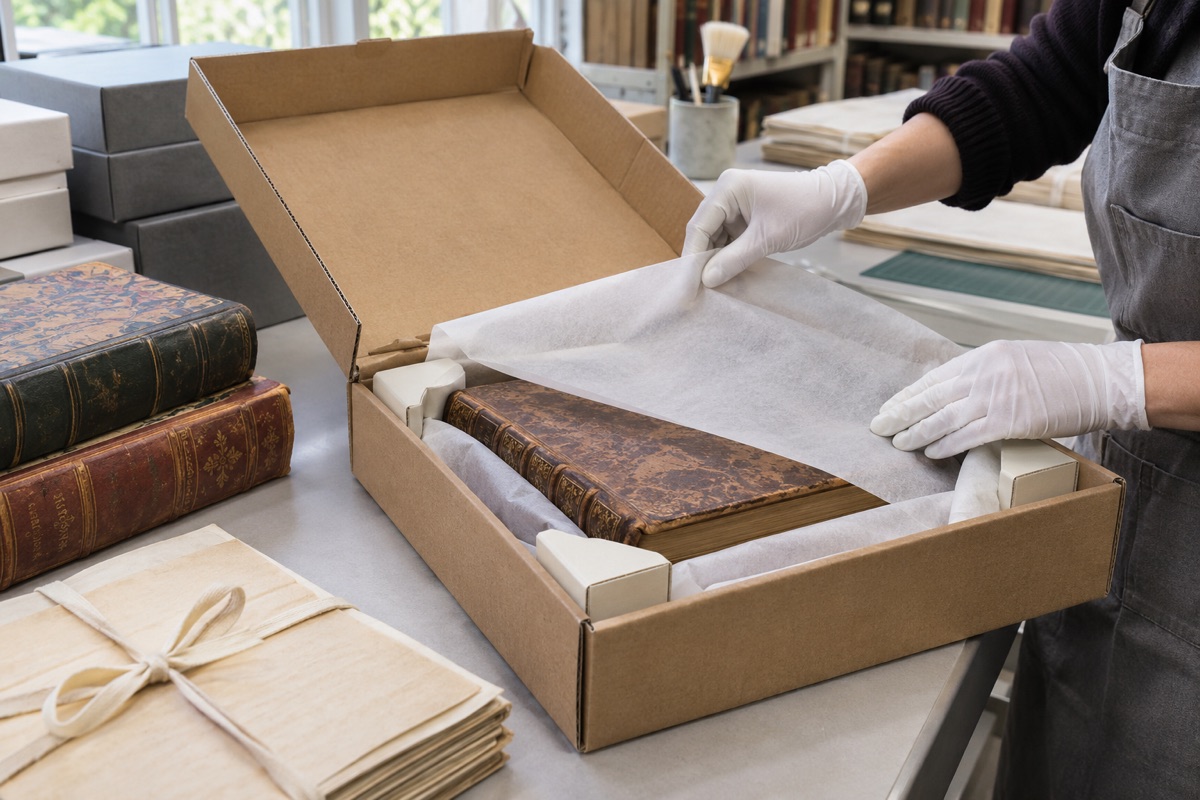
Packaging for rare books, bound archives and print collections is not a substitute for conservation treatment or a suitable storage environment. The aim is to follow the institution’s preservation instructions and create a transport arrangement that limits movement, excessive box weight and loss of inventory information.
Separate collection types and transport purposes
Frequently handled books, fragile bindings, oversized albums and archival files may need different arrangements. First list items by inventory number and shelf or room order; consult the institution’s conservation lead before separating fragile or specially handled pieces. The packing list should link every carton number to its item list.
The Library of Congress advises avoiding boxes that are too large, centering the weight and supporting empty space when packing books for storage or shipping. Do not treat long-term archival storage enclosures and short-term shipping cartons as interchangeable; choose materials under the collection policy.
Book orientation, support and carton weight
Place small and medium volumes flat or spine-down as directed by the institution, with larger and heavier books at the bottom. Use supports that prevent shifting without pressing on covers. Overpacking can create lifting risks as well as pressure on book edges and spines.
Fill voids with measured support; tight compression is no better than loose movement. Do not select interleaving material that will touch sensitive paper or original surfaces without review. If acid or lignin properties matter, confirm them against archival-storage requirements and conservation advice.
Carton closure and inventory chain
Close the top and bottom seams with carton tape suitable for clean, sound board. Tape helps close the box; it does not provide humidity control, archival quality or impact resistance. Include carton number, collection group, destination room and orientation on the outer label. Follow the institution’s privacy rules instead of exposing sensitive inventory details.
If cartons are palletized, distribute weight evenly and place the heaviest boxes on lower layers. Stretch film may unitize cartons on the pallet; it does not replace internal support. Keep barcode and inventory labels visible and scannable after wrapping.
Receipt, opening and relocation
Before dispatch, compare carton count, closure condition and sequence information on the transport record. Photograph and record damaged cartons at receipt before opening; the institution’s lead can determine opening order and update the items’ new locations in the inventory. Assess environmental conditions and water risks if cartons must wait in a temporary area.
The Library of Congress advises against storing valuable collections in uncontrolled places such as basements, attics or garages and highlights the importance of storage conditions. A shipping carton is not a climate-controlled store; follow the collection team’s procedure even during temporary holding.
Sources and further reading
- Library of Congress — How should I pack books for storage or shipping?
- Library of Congress — Preserving Your Books: Storing Your Books
- ISTA — Getting Started with Design & Testing
Accessed 7 November 2026. Confirm current product specifications, carrier requirements and applicable local rules before shipment.
Plan packaging around your operation
Share product dimensions, case layout and dispatch conditions so the suitable Biz2miz packaging options can be reviewed.
Frequently asked questions
Should books be packed upright or flat?
Follow the institution’s instructions for the binding and size. The Library of Congress recommends flat or spine-down placement and heavier volumes at the bottom.
Does carton tape protect books from humidity?
No. Tape closes suitable carton seams; it does not control humidity or make the carton archival.
Does pallet stretch film prevent books from moving inside cartons?
No. It helps unitize the outer pallet load. Items inside each carton still need appropriate support.