
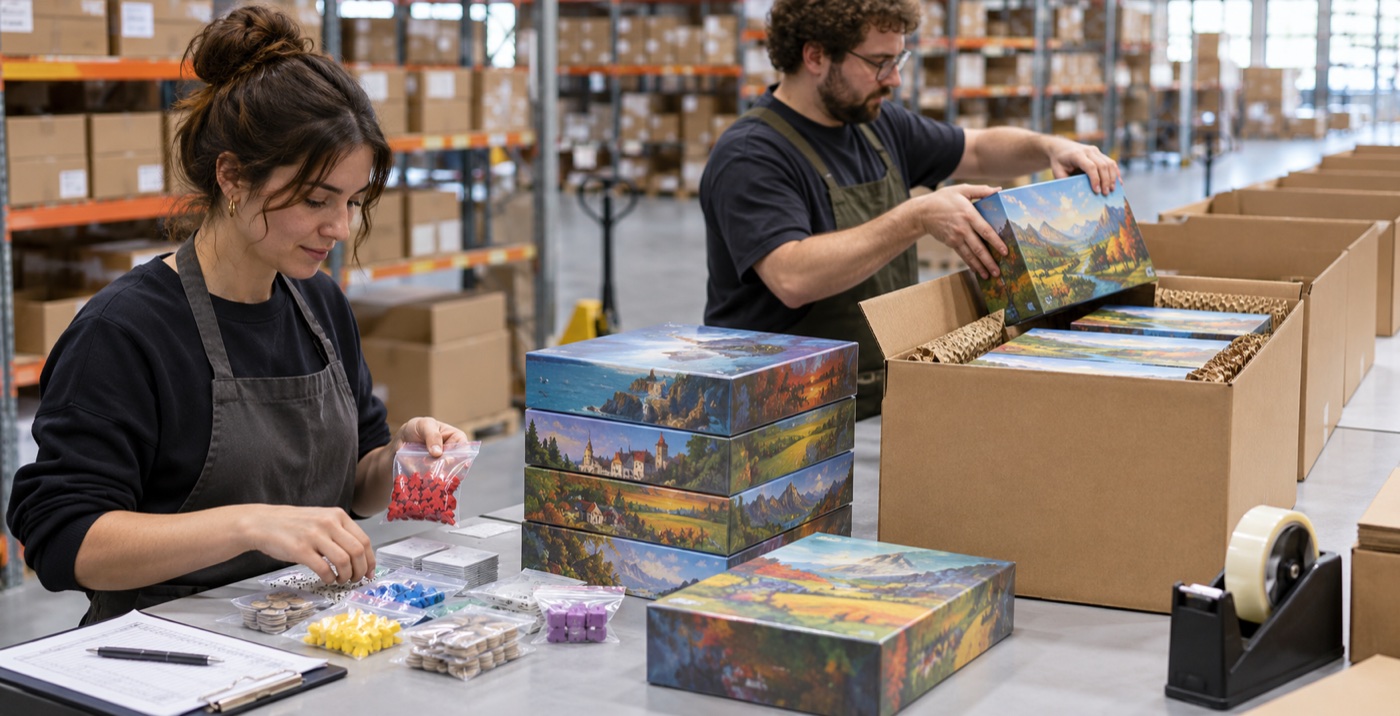
A board-game shipment can fail in more ways than a crushed box: the wrong language edition, a missing deck or tokens from another version can all become order errors. Match the in-box check, carton label and pallet record within one order workflow.
Lock the component bill of materials by edition
Maintain an approved component list for every edition: box, card decks, board, tokens, dice, rulebook and promotional pieces. Manage language, age-grade or channel differences as separate SKUs. Keep the box artwork and version code visible at the packing station with the work instruction.
Choose a count method for each component: sealed card decks, tokens in compartment trays and the correct language code for the rulebook. The adequacy of any sampling plan depends on the manufacturer’s quality system; this checklist is not a formal test standard. When a revision is introduced, do not mix old and new components at the same station.
Control movement inside the box and corner crushing
The board and booklet should remain flat; small pieces should stay in a closed bag or fitted tray. Excess space can let pieces shift and rub the printed faces or corners during transit. Trial the layout in the actual game box. A simple shake check is only an initial screen, not a substitute for distribution validation.
Size the outer carton to protect product boxes from handling impacts and stacking. Add corrugated dividers where units touch. Tape should bond evenly along the case seam. If adhesive must be applied directly to printed game packaging, first check residue and print compatibility on a sample.
Verify SKU and logistics labels
Match the game title, language, edition, quantity and lot on the case to the order record. The GS1 logistics label guideline explains logistics-unit identification and pallet labels. Keep barcodes and shipping labels away from case seams, corner protectors and areas hidden by stretch wrap; verify that they can be read by a person or scanner.
Set pallet stacking to suit carton strength and load distribution. Stretch restraint should not press the box corners inward and should limit load movement. On a trial pallet, inspect top-layer crushing, case shift and product-code readability before dispatch.
Returns and repacking
Do not judge a returned game box by appearance alone. Check the component list and edition, then separate damaged or incomplete sets from saleable stock. Define the replacement carton, tape and lot record in the repacking instruction; remove the old shipping label or fully obscure it.
Sources and further reading
Accessed 3 November 2026. Confirm current product specifications, carrier requirements and applicable local rules before shipment.
Plan packaging around your operation
Share product dimensions, case layout and dispatch conditions so the suitable Biz2miz packaging options can be reviewed.
Frequently asked questions
Which content errors should a board-game kit check catch?
Edition or language mix-ups, missing pieces and incorrect promotional items are useful checks; adapt the list to actual defect records.
Is pallet stretch wrap enough to protect game boxes?
No. Stretch film helps unitize a load; suitable cartons and internal layout are still needed for each box.
Where should the barcode go?
Use a flat, visible and scannable area on the carton, clear of seams and hidden wrap.