
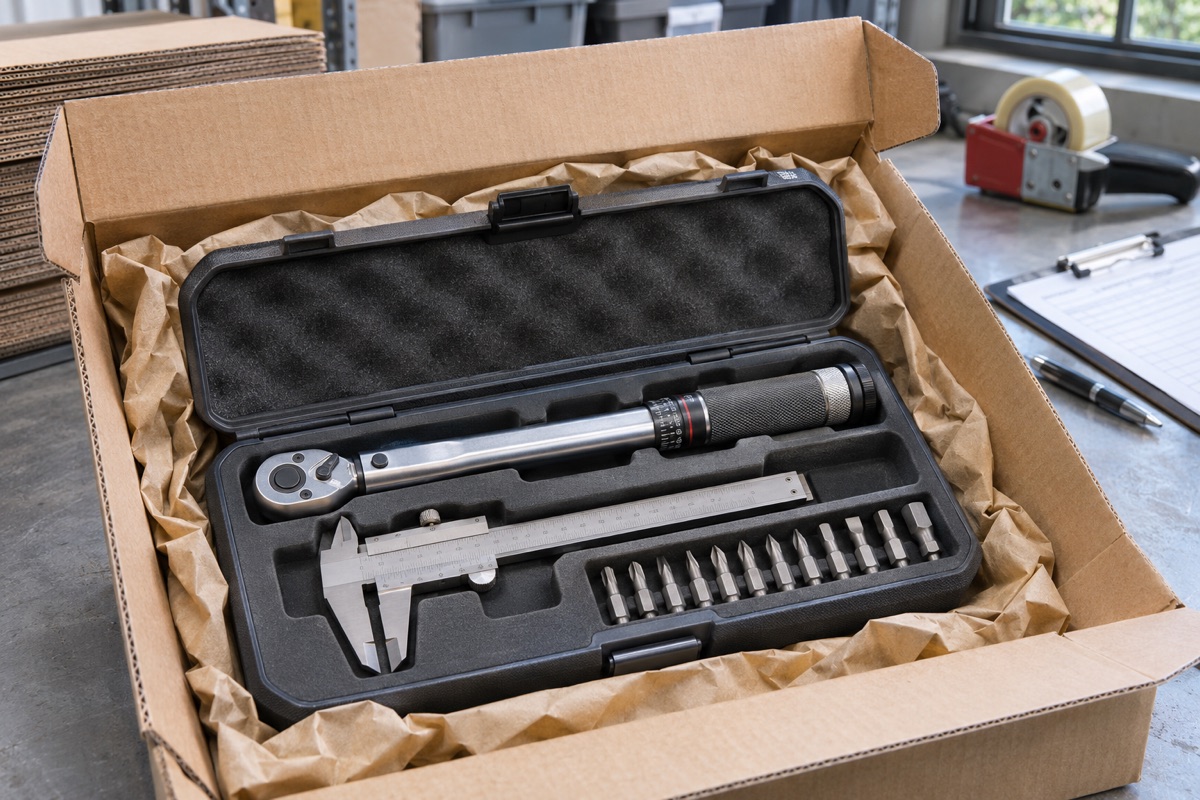
For calibrated hand-tool sets, the dispatch risk is not limited to scratches or breakage; a mismatch between tool, accessory and calibration record can also delay use. Secure torque wrenches, calipers, gauges and bits in separate pockets, and link the outer carton, inner case and paperwork to the serial number.
Match kit contents to calibration records
List kit model, serial number, tool count, accessories and calibration certificate/report reference separately. Transfer calibration date and next-check information only from the valid device record; do not make a technical claim based on the article or outer label. Match the tool’s serial number to its paperwork before dispatch.
Place the certificate in a separate document pocket inside the case or use the digital record link defined by the order process. Do not combine tools with different serial numbers in one undocumented inner pack. The order record should make the serial details on the outer carton traceable to the work order.
Restrain each tool in its own pocket
Torque wrenches, calipers, precision bits and gauge blocks vary in shape and weight. Hold each in a dedicated pocket so metal ends cannot strike measuring surfaces or each other. The closure pressure of the protective case must not load an adjustment mechanism, lock or setting control directly.
Foam or a formed tray can restrain the item, but it does not guarantee calibration stability unless validated by the manufacturer. Check pocket fit and lid clearance with the actual set. If components are oily or dirty, keep them from contacting other tools or certificate paper.
Outer carton, closure and pallet preparation
Position the carrying case in the outer carton so it cannot slide; assess manual-handling weight and carton strength for heavy metal tool sets. Carton tape closes outer flap seams; it does not replace protection for a measuring surface, calibration status or case latch. Place item-code and serial labels where barcodes remain readable.
For consolidated orders, distribute carton weight across pallet layers and set stretch-film tension so delicate inner cases are not crushed. Outer wrap is not a substitute for product testing. Link label data to a GS1 logistics-unit identity so every carton and certificate record can be traced to the order line.
Trial carton and receipt checks
For the first dispatch, pack a representative set and inspect free movement, pocket retention, case latch, certificate match and outer-label readability. ISTA guidance recommends selecting test methods for the package type and distribution channel; the manufacturer and quality owner should set acceptance limits for precision tools.
At receipt, match the serial number to the calibration record again. If damage is found, follow the manufacturer’s or calibration laboratory’s process before putting the tool back into use. A carton that looks intact does not prove that calibration is unchanged.
Sources and further reading
Accessed 7 November 2026. Confirm current product specifications, carrier requirements and applicable local rules before shipment.
Plan packaging around your operation
Share product dimensions, case layout and dispatch conditions so the suitable Biz2miz packaging options can be reviewed.
Frequently asked questions
Where should the calibration certificate go?
Use a dedicated pocket in the kit or the digital record defined by the process, and verify the serial-number match before dispatch.
Does a foam insert preserve calibration?
It can reduce movement, but it is not a calibration guarantee without manufacturer validation.
Does pallet stretch film restrain precision tools?
It unitizes cartons on the pallet; it does not replace restraint inside each tool case.