
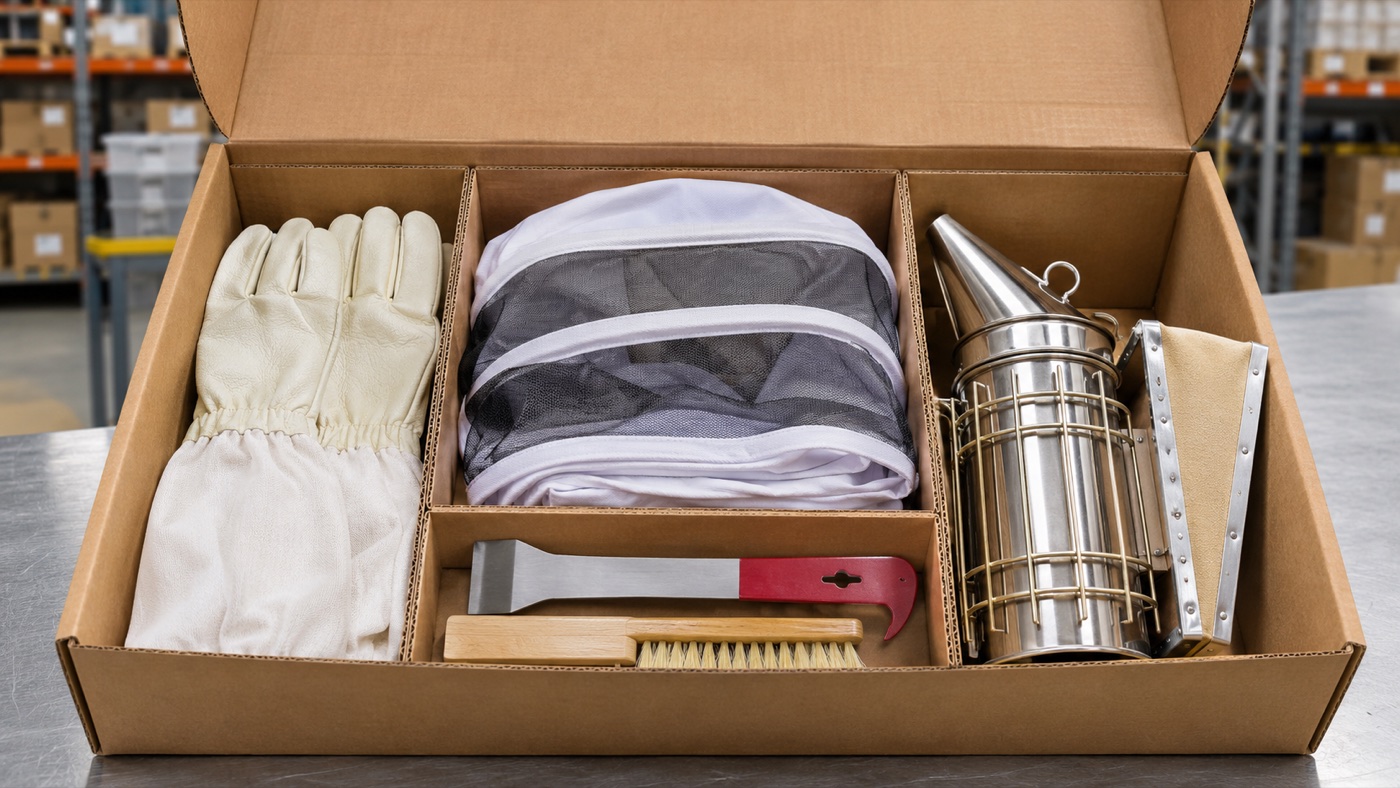
Beekeeping starter kits often combine parts of different materials and sizes: protective clothing, gloves, hive tools and instructions may share one carton. Separate the items to avoid contact damage and match the kit contents to the order at the packing station.
Kit list and size matching
List the protective suit or jacket, gloves, veil/hood, hive tool, smoker or small fittings by variant. If one kit name includes different clothing sizes or protective-gear variants, track each as a separate SKU. The size and model packed must match the outer label and order line.
Keep metal tools in a compartment separate from textiles. Cover pointed or sharp edges with a product-appropriate guard and confirm on a sample that it stays in place in transit. Do not place loose tools inside the folded suit; metal can abrade the fabric.
Control movement and manage moisture
Pack folded clothing in a clean, dry inner bag or package with the kit list visible. Store veils and gloves according to their own product instructions. Hive tools, fittings and small accessories should be countable in a separate closed inner pack.
If the carton has excess space, add dividers to limit movement. Apply carton tape along the outer case seam; do not stick it to protective clothing or product fabric. Where dusty or damp storage is a concern, define the inner-pack and outer-carton conditions for the actual operation. Stretch film helps restrain an external pallet load only.
Label and pallet checks
The carton label should identify kit name, size/model code, quantity and order or lot information. Keep the barcode on a flat, scannable surface clear of tape, corner protectors and pallet wrap. The GS1 logistics label guideline’s unit-identification approach can help connect cartons to pallet and dispatch records.
Arrange pallet layers around carton weight and base dimensions. Validate wrap tension on a sample load so cases do not collapse inward or compress protective garments. At receipt, compare the carton condition, set count and missing-item records.
Returns and repacking
Before restocking a returned set, apply the business procedure for cleanliness, integrity and completeness of protective clothing, gloves and tools. Do not treat used or damaged protective equipment as new. A repacked set’s new label must not be confused with an old barcode or order number.
Sources and further reading
Accessed 3 November 2026. Confirm current product specifications, carrier requirements and applicable local rules before shipment.
Plan packaging around your operation
Share product dimensions, case layout and dispatch conditions so the suitable Biz2miz packaging options can be reviewed.
Frequently asked questions
Should metal hive tools share an inner compartment with the suit?
No. Separate them and guard suitable edges to reduce abrasion or cutting risks to the fabric.
How should different sizes in a kit be distinguished?
Match size/model information through separate SKUs, inner packs or compartments and the outer carton label.
Does stretch wrap protect protective clothing from moisture?
Pallet wrap is not an inner-pack barrier; assess the garment’s own packaging and storage conditions separately.